
Francesca Tolot – MAC Masterclass
Wednesday, October 8th, I was invited to attend a truly exceptional event at the Triennale of Milan: a MAC Masterclass held by extraordinary Francesca Tolot and the presentation of her book One Woman 100 Faces. A very exciting experience, I must say – almost touching, actually – and I’m afraid I won’t be able to express in words the intensity of those moments, which merged art, culture, beauty (even in the most conceptual sense of the word, not just on a purely aesthetic plane) and sheer intelligence together. Francesca Tolot is a professional, an artist of the highest level you can imagine. And, as it almost always happens, the most capable at the workplace prove to be at their best even as humans, almost as if there were a direct relationship between talent and human qualities. Talent, artistic sensitivity, modesty, kindness, helpfulness, friendliness, professionalism: all these features at their highest peak, if I were to describe Francesca Tolot. She gave us so much, this amazing make-up artist, and I hope these few words will make it to at least convey a part of the gift we got.
Francesca Tolot was first introduced by another excellent professional, Michele Magnani, another example of a great talent and a great person at once. Everybody knows, at least in broad terms, the extraordinary career of Francesca Tolot: she worked with the greatest photographers of all time (Helmut Newton and Herb Ritts, among others), and the list of her editorial works and advertising campaigns is endless. She has made-up the greatest celebrities of our time: Elizabeth Taylor, Madonna, Beyoncé and many others.
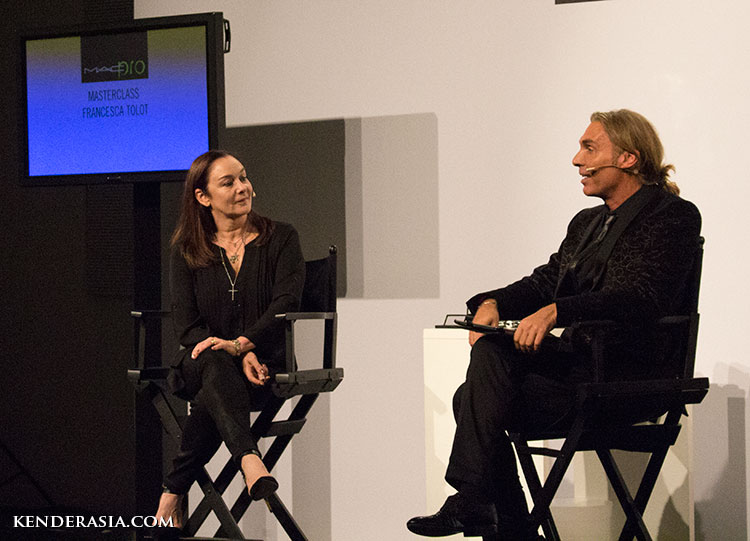
Francesca has told the class about herself without reservations, generously answering Michele’s questions, giving an interview that is also a discourse on art and a great lesson in professionalism.
To answer the question «Where did Francesca Tolot ‘buy’ her talent from?», Francesca told us how much she owes her master, Diego Dalla Palma. Francesca already has art in her blood: she comes from a family of artists, creative people. A family environment whose members are used to pour their intellect into their own hands to create art. What made Francesca Tolot become a professional make-up artist? Paradoxically, make-up has never been an aspiration for Francesca. One day she met Diego Dalla Palma and decided to attend a course he was holding at his earlier Make Up Studio, just for her own fun, for personal pleasure. From that came the first project that turned out to be a negative experience: Francesca did not like the environment, the methods. But soon the opportunity for a second project came about and Francesca found herself in the studios of Vogue Italia. Since then things were never the same again: there was art in there, inspiration and creativity. It wasn’t long before she moved to Los Angeles. The choice of that city may seem peculiar, as many artists rather choose to live in New York, but Francesca and Alberto Tolot were then looking for tranquility and they made it a lifestyle choice.
The difference between the aesthetic code of Europe and that of the United States was of considerable impact. These were two very different paradigms in terms of appearance and sensitivity. Hollywood was at that time very ‘oldish’ and privileged very ‘heavy’ looks. Francesca ‘rejuvenated’ that whole world, bringing new lightness and freshness to it. She taught it to remove rather than to add. She brought the awareness that all that makeup wasn’t really needed, after all.
How has being artist Francesca Tolot evolved over the years? You always learn something from the diverse experiences you go through. The book One Woman 100 Faces is a collection of experiments, a project that was carried out in complete freedom, without any kind of pressure whatsoever. Francesca is very keen on emphasizing the power of her team, as her work is always about collaboration and partnership. When there is harmony in the team and everybody is oriented toward the same goal and has the same artistic perception, results are always achieved. The type of work Francesca prefers is editorial, yet the project she is most proud of is the one she developed for the movie Dreamgirls starring Beyoncé. A project of this kind requires very extended timing, compared to editorial work. Make-up in this case was all played on the sequins that form the make-up itself.
The book One Woman 100 Faces collects various works with Mitzi Martin over a period of about 10 years. When I asked why the choice fell right on Mitzi, Francesca replied that she first met Mitzi Martin when she was 17 and she’s always found in her the same wonderful personality. She found a European publishing house based in London because the United States were still obsessed with celebrities and it wouldn’t have been possible to carry out the work in total freedom.
If you’re wondering where Francesca Tolot finds her inspiration, well, she does not set any extreme goals, but rather lives each experience to the full. She finds inspiration in each and every context: from art all the way down to nature. All that matters is to always keep your eyes open and keep observing. In case your desire is to venture into a career as a make-up artist, Francesca insists that strong passion and love for the work is the secret of success. And studying is essential, in order to have a good grasp of the basics. Passion combined with humility and being open to learn, every single day. Social media are a double-edged sword: you need to be careful what photos you post on Instagram, for example. It is essential to always respect the work of others.
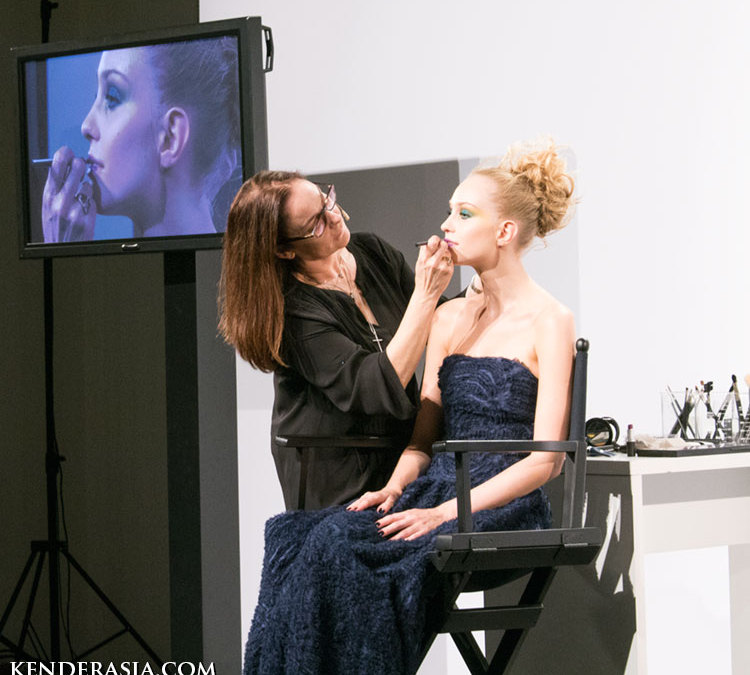
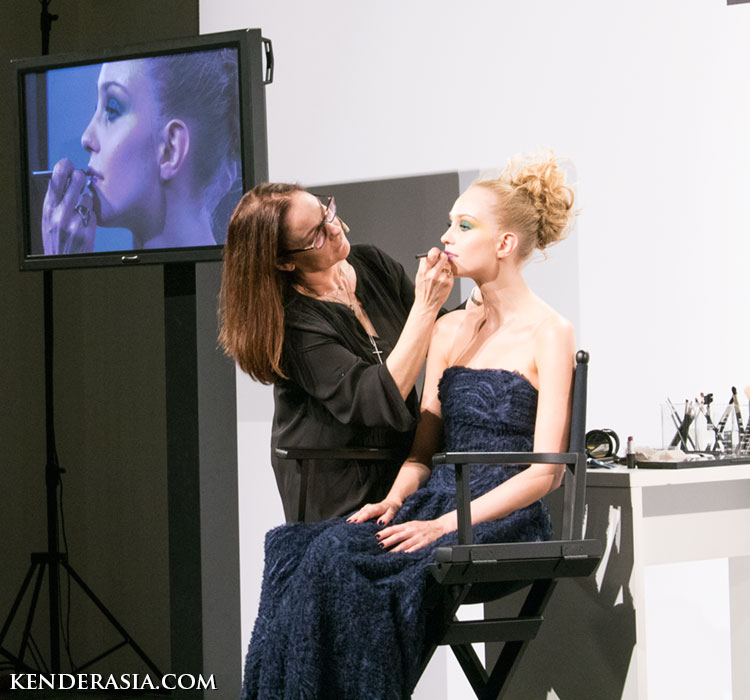
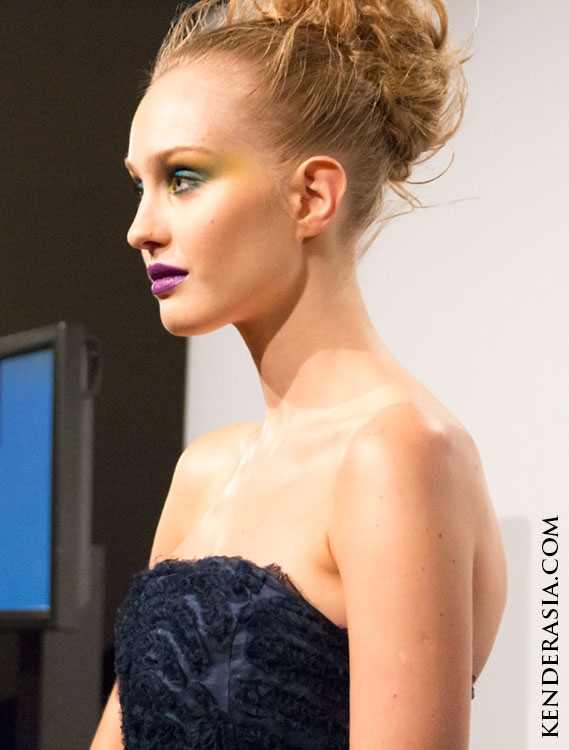
Francesca then created a make-up which is later found in the book, on beautiful model Christine. The inspiration came from the Pre-Raphaelites artists, and namely from J.E. Millais’s painting of Ophelia: the theme here is definitely aquatic, with nuances of more or less intense green, turquoise and yellow. Francesca Tolot loves colors and loves to blend them. In this case, we have colorful smoky eyes, a revisited classic that always successfully intensifies the look. She used eye crayon which she always blends, seamlessly, right from the beginning. Francesca simultaneously works on both eyes, first on both upper eyelids and then on both lower ones. Blending using the fingertips is not an issue, it is actually the expression of her need for tactile contact with the color. The secret is to use colors and products in transparency, applying color little by little and mixing different shades to get the most intense 3D effect possible. For this make-up she used very strong, flashy colors as if they were watercolors. The final touch: kajal – essential for an intense look – and mascara on the lower lashes for a broader look, and purple lips, in a tone created ad hoc.
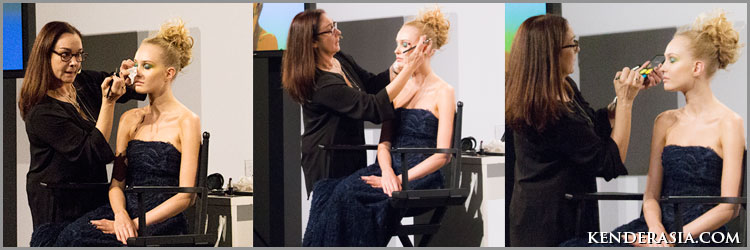
The quality of cosmetic products is improving day by day and goes hand in hand with their increased availability. Francesca’s favorite foundation is creamy liquid (unless the skin being treated hasn’t specific issues that require stick foundation). It is key to use light textured foundations that are transparent and have an adjustable cover up effect.
At this point, Diego Dalla Palma raised a question: how to interpret the use of Photoshop and photo editing? Francesca bluntly admits how the instrument is used way too much and way too badly, when in itself could be used in a very creative way. But in reality, on a commercial level, it often destroys the precious work of make-up artists. A similar discussion may be applied to corrective make-up. Francesca observes how contouring has become a real obsession: a technique that has been more and more exaggerated and often not necessary, that easily becomes ridiculous. The problem common to photo editing and corrective make-up is that the goal, as well as the end result, is to completely remove the individuality of the model, making facial features indistinguishable. Erasing what makes a person’s face unique not only cancels one’s personality, but also cancels the beauty of each individual.
To conclude of the masterclass, here are Francesca’s favorite MAC products: lipsticks and eye shadows, in the first place, given her passion for color, and the Extra Dimension mascara and the Strobe Cream.
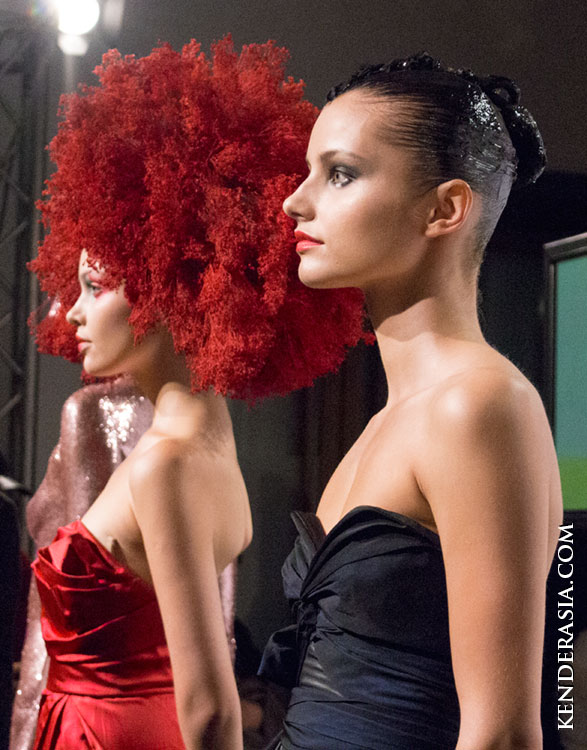
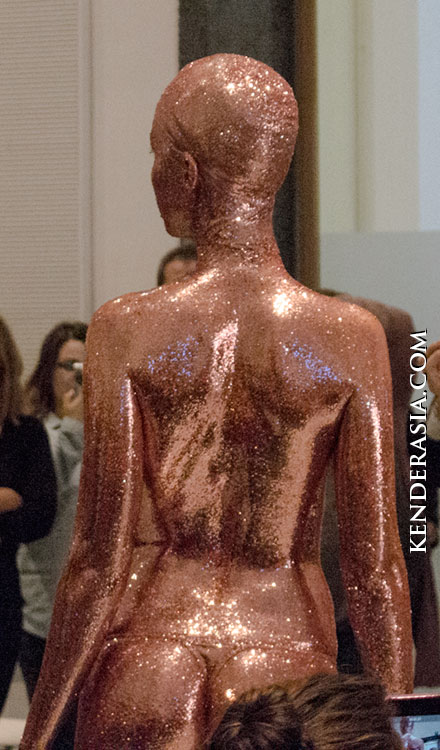
The masterclass ended with a show featuring a few amazing works of Francesca’s that were recreated on the models.

Grazie mille per la testimonianza! Ripeto: avrei voluto esserci davvero un sacco, deve essere stato meraviglioso.
È stata un’esperienza quasi mistica 😀 spero di essere riuscita a rendere anche solo un parte di tutta quella bellezza 🙂